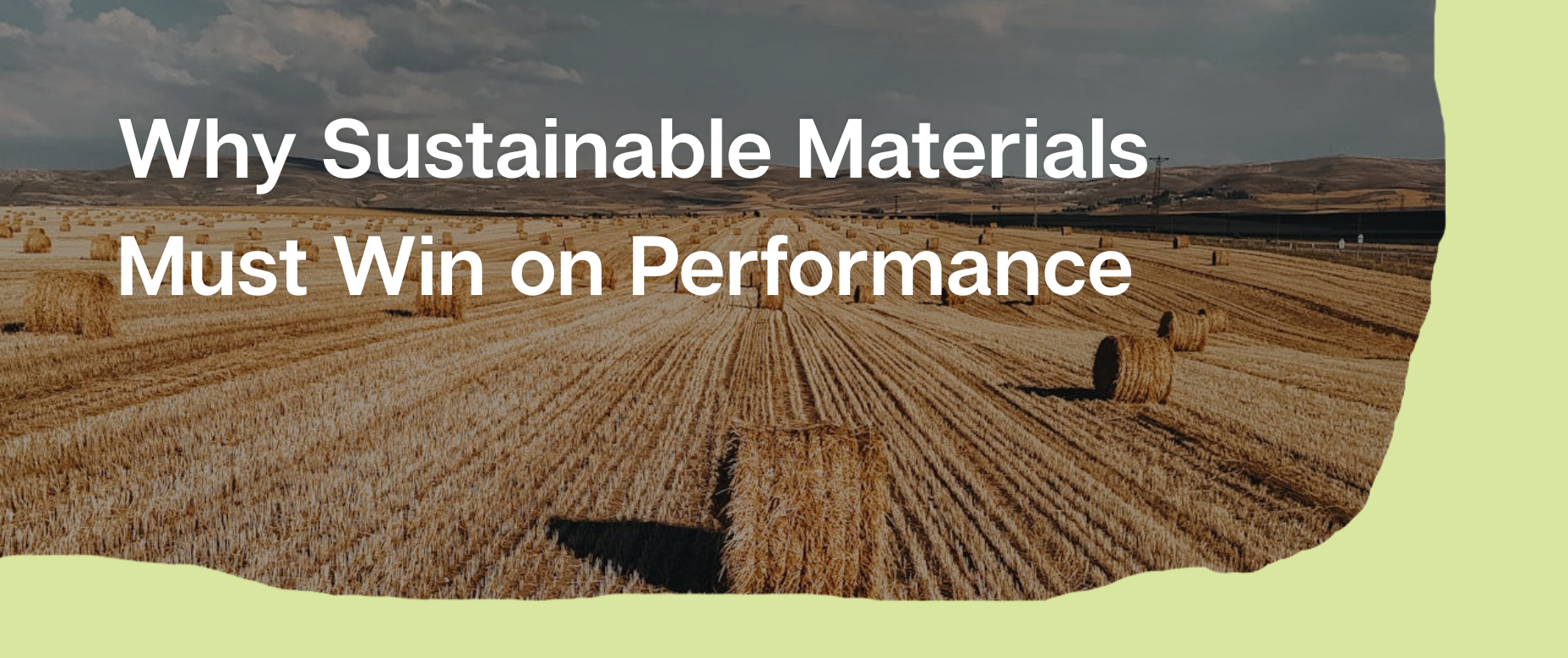

Industrial materials still rely heavily on fossil-based chemistries, from thickeners in cosmetics to adhesives in construction. Meanwhile, more than a billion tonnes of rice straw, sugarcane bagasse, and other crop residues are burnt or left to decay each year, especially across the Global South.
And while industry interest in sustainability has grown, adoption still rests on three variables: performance, reliability, and cost. That has been consistent across our own experience building altM. Climate intent on its own rarely creates pull. What drives integration is when a material performs as well as, or better than, what it intends to replace, and at economics that holds up in a real supply chain.
Conventional materials have dominated for decades because they meet this bar. If sustainable materials are going to matter at scale, they have to compete on the same scoreboard. For us, this framing has been helpful because it anchors the work in engineering reality rather than narrative.
The Shift From “Green Alternatives” to Practical Materials
Circular chemistry and biomass-based building blocks can now achieve specifications that were out of reach even a decade ago. Agricultural residues like rice straw, husk, or bagasse may appear low-value in raw form, but structurally, they carry the complexity needed to design high-performance materials.
The challenge has never been the biomass itself; it has been the ability to convert it consistently, repeatably and at industrial volumes. That’s where we have spent most of our time at altM. Some of our own work illustrates this shift; for example, altScreen™, our biodegradable SPF booster, raises sunscreen protection by ~2.87× at just 2% loading. Its performance comes from controlled lignin transformation through our altMorph™ process, not from sustainability positioning.
Petrochemicals powered the 1950s; alternate materials will power what comes next. That shift won’t happen because the world wants it to, but because the materials themselves begin to outperform the incumbents.
Where the Hard Work Happens
A significant portion of our effort goes into understanding variability in biomass and designing chemistry that absorbs those variations rather than amplifying them. Scaling this chemistry requires equipment that behaves predictably under different loads, temperatures, and flow conditions.
The move from bench to demonstration scale, and now to a 50-tonne pilot, has shaped our engineering work in very practical ways. As volumes increase, material handling, reaction control, and process integration all evolve, and our systems have been built around managing those shifts with consistency.
Once these pieces settle into place, the materials stop being framed as alternatives. They simply become workable options that fit into industrial reality.
Performance Is Already Reshaping the Category
The next wave of sustainable materials is already underway and we see it directly in our own development pipeline. Circular and biomass-based chemistry is now hitting specifications in categories that sit quietly inside everyday products: thickeners, resins, additives, intermediates, where performance used to be the main reason bio-based options were set aside.
We’re supplying and scaling materials in several of these categories today. The shift is tangible - skepticism has gradually turned into detailed technical conversations, followed by pilot trials and commercial sampling. None of this has been driven by sustainability claims. It has been driven by the materials doing their job.
How This Shapes the Way We Work
At altM, this performance-first mindset has influenced everything from how we run R&D to how we approach scale-up. The goal has always been to engineer materials that meet commercial specifications, integrate smoothly into existing supply chains, and scale without compromise. Sustainability emerges naturally from that approach, but it is never the starting point.
This is the type of work that, in our view, will determine whether sustainable materials become mainstream in sectors that rely on reliability above everything else.


