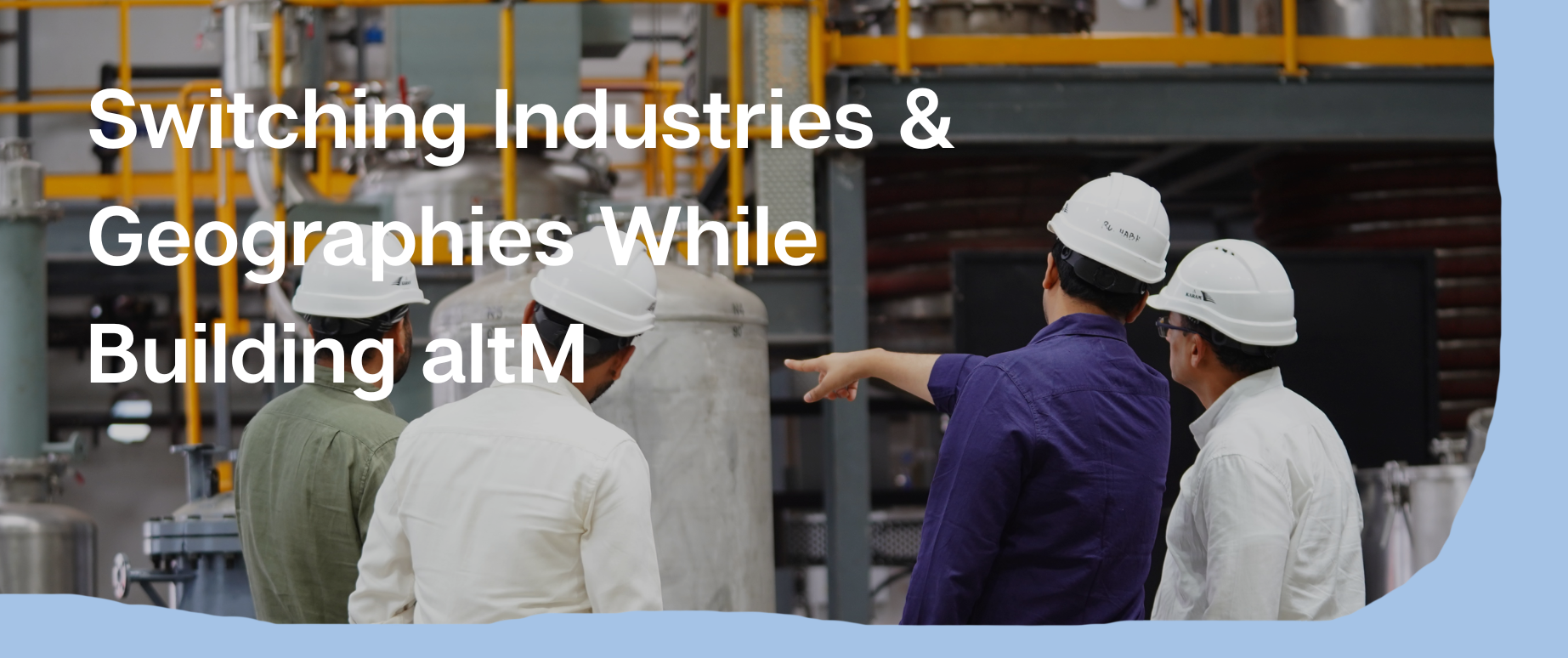

Changing industries while building altM has been both super fun and genuinely painful, in two distinct ways. The first was switching industries, from automotive into chemicals and materials. The second was switching geographies, from the US back to India. Each transition came with its own learning curve, and together they reshaped how I think about building something from first principles.
Before starting altM, a materials science company building scalable, bio-derived alternatives to petrochemicals, I studied in the US and spent several years working there, including time at Tesla in manufacturing and engineering roles. That experience shaped how I think about execution, pace, and scale, and provided a strong foundation for building systems and teams. Transitioning into the chemicals and materials space, and doing so from India, required relearning many of those lessons in a very different context.
While the fundamentals of manufacturing stay remarkably consistent across industries, the way projects move, how decisions get made, how scale-up works, and how value is created can feel very different. That became clear early on. Entering the chemicals and materials space meant relearning not just technical concepts, but also how timelines stretch, how credibility is earned, and how risk is evaluated in ways I had not experienced before.
Our early ramp-up happened in a pre-GPT world, and it was slow by design. We spent months collecting domain-specific biochemical knowledge through conversations, over 200 of them, across industry and academia in India, Europe, Africa, the US, and East Asia. The goal was not just to learn the science, but to understand why altM’s thesis had not already been executed at scale. Over time, our meeting notes became more structured. We read extensively, questioned assumptions, and spent long hours with our CSO, Dr Harshad, who has been a teacher to both Apoorv and me throughout this journey.
Being outsiders to the chemicals and materials industry was uncomfortable at first. But it also came with an unexpected advantage. Not having inherited assumptions made it easier to question things that would otherwise fall into the category of how things have always been done. That freedom helped shape how we wanted to approach materials and manufacturing, even if it made the early phase slower and more painful.
The geographical shift back to India introduced its own layer of complexity. Things here move slower than what I was used to in the US, especially in the early stages. Infrastructure, procurement, coordination, and execution required more persistence than expected. At the same time, now that our lab and pilot operations are built and running in Bengaluru, it is clear that we can do significantly more with the same quantum of capital and resources here than we could in many other geographies. That leverage compounds once the fundamentals are in place, and it has reinforced why building altM here made sense.
There has not been a single silver bullet that has made altM work so far. Progress has come from hundreds of small, often unglamorous decisions taken consistently over time. Even with our limited history as a company, we now have a growing list of contacts, suppliers, contractors, reference points, and hard-earned experience on what it takes to build a deeptech hardware startup, a team, a lab, and a pilot plant in India.
I am sure my perspective on this journey will continue to evolve over the coming years. It already has. Much of how I think about building today is still shaped by the people and teams I worked with in the US, and I remain grateful for those experiences. Building altM has not been about replacing one worldview with another, but about combining them and learning where each applies best.
If any of this is useful to others attempting a similar transition, across industries or geographies, we are always open to sharing what we have learned. The goal should be to maximize collective time spent solving real engineering and business problems, rather than repeatedly rediscovering administrative or structural lessons. That is what will be required to reinvent industries that have not meaningfully changed in decades.


