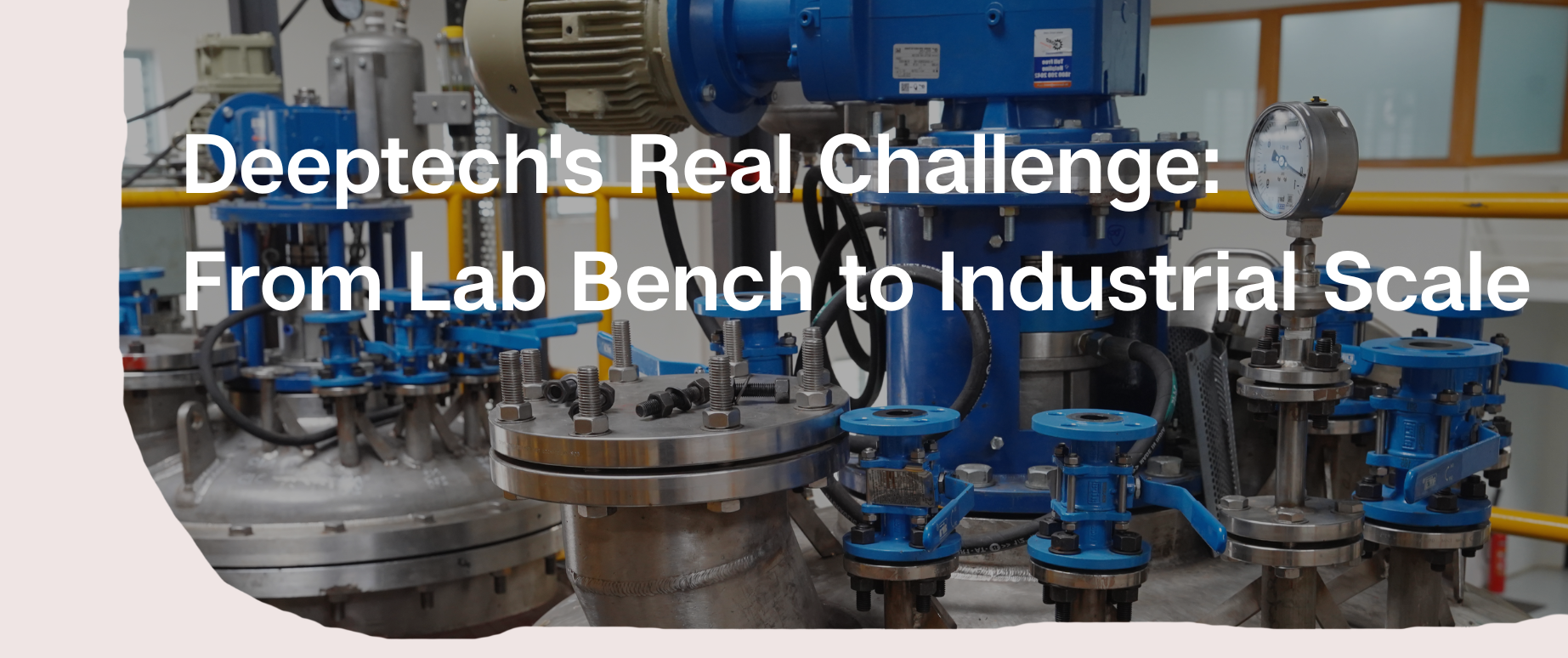

In the dynamic world of deeptech, the allure of groundbreaking scientific discoveries often overshadows the arduous journey from laboratory success to industrial-scale implementation. While a scientific breakthrough is undoubtedly the genesis of any deeptech venture, it is merely the first step. The true crucible for deeptech innovation lies in its ability to scale, a challenge that demands far more than just scientific prowess. Industrial readiness, not science, decides who wins.
The Illusion of Lab Success
Many deeptech narratives begin with a triumphant moment in the lab – a novel material synthesized, a new process discovered, or an efficiency benchmark shattered. This initial success, while validating the scientific premise, can create a deceptive sense of accomplishment. The transition from a controlled laboratory environment to a robust industrial operation introduces a myriad of complexities that are often underestimated. We often assume deeptech starts with a breakthrough in the lab. It doesn’t (or at least didn’t for us at altM). It starts when that breakthrough can survive contact with the market and with capital.
The Pillars of Industrial Readiness
Scaling deeptech is fundamentally about building resilient systems. It necessitates a holistic approach that integrates technical, market, and capital readiness. Technical readiness has limited tangible meaning without market and capital readiness. And those three systems have to evolve together.
Supply Chain Stability
One of the most significant hurdles in scaling deeptech is establishing a stable and efficient supply chain. Unlike traditional industries with well-established networks, deeptech often relies on novel inputs or processes, requiring the creation of entirely new supply ecosystems. The challenge isn't a lack of demand for innovative solutions, but rather the absence of supply chains capable of delivering at the right unit economics and consistency.
At altM we focus on harnessing readily available agricultural residues as primary input materials, transforming them into high-performance ingredients. This requires meticulous engineering of the entire process, from aggregation and preprocessing of biomass to thermochemical deconstruction and catalytic upgradation, ensuring a consistent and cost-effective supply.
Process Control and Cost Discipline
Moving from batch production in a lab to continuous, high-volume manufacturing demands stringent process control and unwavering cost discipline. Every variable, from temperature and pressure to reaction times and purification steps, must be precisely managed to ensure product quality and consistency. Furthermore, the cost structure must be meticulously engineered to achieve commercial viability. We realized that our initial cost structure only made sense if we reimagined the unit entirely, necessitating a re-engineering of the process and the platform to meet desired cost, scale, and performance targets.
Uptime and Reliability
Industrial operations cannot tolerate downtime. Ensuring continuous uptime and reliability of equipment and processes is paramount for meeting production targets and maintaining customer trust. This requires robust engineering, predictive maintenance, and a deep understanding of operational nuances. Our pilot plant in Bengaluru serves as a critical stepping stone, designed not just for testing but for scaling, demonstrating their commitment to industrial readiness.
Go-to-Market as an Extension of R&D
A common pitfall in deeptech is treating go-to-market (GTM) strategy as a post-R&D activity. However, for deeptech and climate tech ventures, GTM must be an integral part of the research and development process itself. Designing for scale – considering materials, costs, suppliers, and regulatory pathways – from the outset not only de-risks the commercialization journey but also becomes a technical moat. We designed for scale across all critical product attributes...and this has become a key differentiator for us.
The Strategic Role of Capital
Securing the right kind of capital is another critical aspect of scaling deeptech. Traditional funding models may not always align with the non-linear development pathways and longer time horizons often associated with deeptech. Investors need to understand that deeptech doesn't follow a straight line, and the capital stack must reflect this reality. What kind of capital matches our time horizons and inflection points? What is the right capital to not just prove an idea in the lab, but to build it into a legitimate commercial proof of manufacturability? The answers aren't just in the breakthrough, but in how the technology, costs, market, and pathway converge.
Collaboration: The Engine of Scale
Innovation, particularly in deeptech, cannot thrive in isolation. Scaling complex technologies requires a collaborative ecosystem of specialists. Our journey so far s is built on this principle, actively partnering with scientists, engineers, and customers. This includes collaborating with scientists experienced in biomass transformations, engineers adept at scaling from grams to tons, and customers who ensure that the molecules function effectively within real-world supply chains. This open, collaborative approach is fundamental to making bio-based materials mainstream and building solutions that truly last.
The journey from a promising lab result to a thriving industrial enterprise is fraught with challenges, but it is precisely this journey that defines the success of deeptech. By prioritizing industrial readiness – focusing on supply chain stability, process control, cost discipline, uptime, integrated GTM strategies, strategic capital, and collaborative partnerships – deeptech companies can pave the way for a future where groundbreaking science translates into tangible, scalable, and sustainable impact. The future of materials, and indeed the future of our planet, hinges on our collective ability to bridge this gap and embrace the complexities of industrial scale.


